
0%

An AC DC Dual Output Power Supply converts incoming alternating current into two usable output channels. In most industrial designs, both channels provide direct current, such as 24 volts and 5 volts. These separate rails can power a motor controller and its sensors at the same time. AC-DC Dual Output Power Supplies are common in automation panels, laboratory instruments, communication equipment, and compact control systems.

A practical example is a factory control cabinet. One output may run a 24-volt PLC, while the second supports a 12-volt display or relay circuit. This arrangement can reduce wiring space and simplify voltage management. It may also improve system stability when each load has different current demands. However, output ratings, isolation, regulation, and cross-load performance deserve careful checking. A label showing two voltages does not guarantee independent operation. Check the datasheet.

The term can cause confusion. Some suppliers use “dual output” for two DC outputs, while others describe a supply with AC and DC output options. Confirm the product architecture before selecting it. During hands-on testing, engineers should measure voltage under both light and full load. Heat around the terminals can reveal problems that a specification sheet misses. Protection features matter too, including overload, short-circuit, and over-temperature protection. Reliable supplies need more than impressive numbers. They need suitable certification, clear documentation, and stable performance over time. Even experienced designers can overlook startup current or shared-ground limitations. That small oversight may become a costly failure.
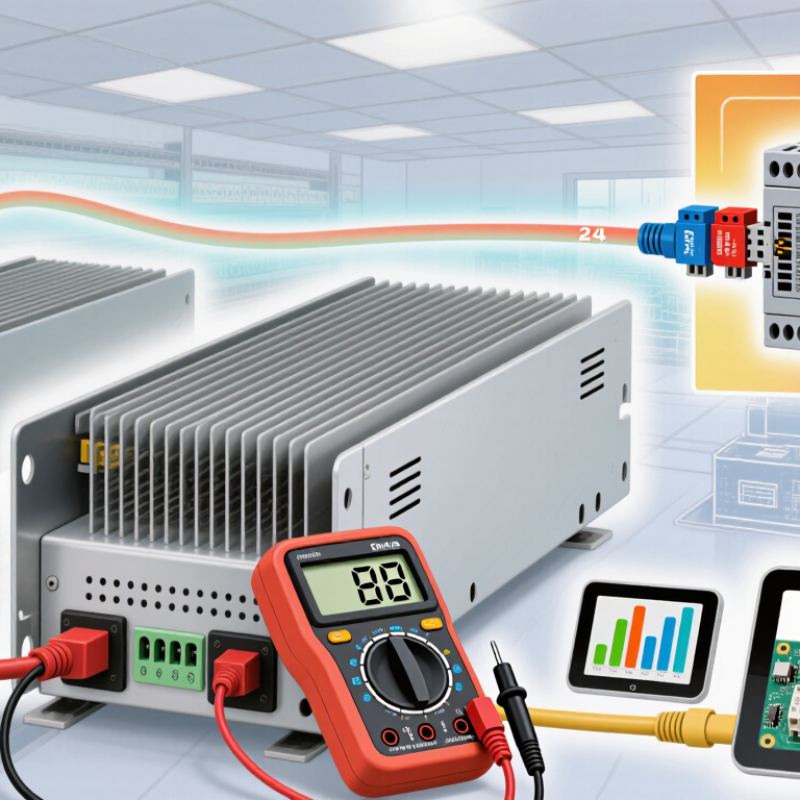
What Is an AC DC Dual Output Power Supply?

Definition and Function of an AC/DC Dual Output Power Supply

What Is an AC DC Dual Output Power Supply?

An AC/DC dual output power supply converts alternating current from a wall outlet into two regulated direct-current outputs. Each output can deliver a defined voltage and current for electronic circuits, control panels, sensors, or laboratory equipment. Some models provide independent outputs, while others connect them in series or parallel. The exact function depends on the internal design.

A key benefit is flexibility. One output may power a control board at 5 volts, while the second supplies a motor or relay at 12 volts. In a practical test, technicians should measure both channels under load, not only at no-load conditions. Output voltage can shift when current demand rises. That detail is easy to overlook.

Check the wiring carefully.

Many dual-output supplies offer isolated channels, which can reduce ground-loop problems and improve circuit safety. However, isolation should never be assumed from the product description alone. The datasheet should state isolation ratings, current limits, ripple, protection methods, and operating temperature. A unit with two terminals may still share a common ground.

The supply also needs suitable overload, short-circuit, and thermal protection. Ventilation matters, especially inside a crowded enclosure. I would avoid choosing a model only by its maximum wattage. Real reliability depends on continuous load, startup current, ambient heat, and wiring quality. Specifications help, but a controlled test often reveals weaknesses that the label does not.

How AC and DC Outputs Work Together

What Is an AC DC Dual Output Power Supply?

How AC and DC Outputs Work Together

An AC DC dual output power supply delivers alternating current and direct current from one controlled unit. AC output can operate motors, relays, heaters, or transformers. DC output supports sensors, controllers, displays, and communication circuits. Both outputs share one enclosure, but they require separate regulation and protection.

A factory cabinet makes the function easy to picture. The AC side may drive a small motor, while the DC side powers its control board. Isolation helps prevent motor noise from disturbing sensitive electronics. Designers also check voltage stability, grounding, overload response, and startup timing. A dual output is not automatically safer. Poor coordination can still create heat, interference, or unexpected shutdowns.

Energy demand makes this design increasingly relevant. The International Energy Agency reported that data centers used about 460 TWh of electricity in 2022. It expects demand to exceed 1,000 TWh by 2026. The Uptime Institute’s 2024 Global Data Center Survey reported an average power usage effectiveness value of about 1.56. These figures show why conversion losses deserve attention. Every unnecessary conversion adds heat. That lesson is easy to overlook. In practice, I would measure each rail under real load, not only trust the specification sheet. IEC 62368-1 also emphasizes hazard-based safety evaluation, including energy, fire, and electric shock risks. A careful design treats AC and DC as cooperating systems, not separate conveniences.

What Is an AC DC Dual Output Power Supply?

This waveform shows how a nominal 24 V RMS AC output alternates around zero while a regulated 24 V DC output remains nearly constant. The AC waveform is based on a 50 Hz cycle, with a peak voltage of approximately 33.9 V.

Key Components and Output Specifications

An AC/DC dual-output power supply converts mains AC into two regulated DC rails. Its core path usually includes an input fuse, EMI filter, rectifier, transformer, switching controller, and output rectifiers. A feedback loop adjusts switching duty cycle when the load changes. Isolation barriers and thermal sensors protect users and connected equipment.

Output specifications deserve closer attention. Engineers should check voltage tolerance, maximum current per channel, total wattage, ripple, noise, line regulation, and load regulation. For example, a 12 V/5 A and 5 V/3 A supply provides 60 W and 15 W separately, but its combined rating may be lower than 75 W. Connector polarity matters. So does the minimum load.

A 2024 MarketsandMarkets report estimates the global AC-DC power supply market will grow from about USD 33 billion in 2024 to over USD 46 billion by 2029. This growth reflects demand for compact, efficient conversion systems. The U.S. Department of Energy’s external power supply standards also emphasize no-load consumption and average active efficiency. A supply can pass nominal voltage tests yet perform poorly during sudden load changes. Ripple measurements should use proper bandwidth limits and short probe connections. Specifications alone are not enough.

Common Applications in Electronic Systems

What Is an AC DC Dual Output Power Supply?

Common Applications in Electronic Systems

An AC DC dual output power supply provides alternating current and direct current from one controlled unit. This arrangement supports systems containing different electrical loads. For example, an AC output can drive a small motor or transformer, while a regulated DC output powers sensors, displays, and control circuits. The setup looks simple. It is not always elegant.

Engineers often use these supplies on electronic test benches. A prototype controller may need 24 V DC for relays and 5 V DC for logic circuits. At the same time, an AC output can simulate an incoming equipment supply. Technicians can observe startup behavior, voltage drops, and load changes without rebuilding the entire test setup. In industrial control panels, dual outputs can separate actuator power from sensitive measurement circuits. This separation may reduce interference, but grounding still requires careful checking.

Telecommunication equipment, automation modules, laboratory instruments, and battery-charging systems can also use this architecture. The correct model depends on output voltage, current capacity, regulation accuracy, ripple, isolation, and thermal performance. A power supply rated for two outputs may not deliver full power through both simultaneously. That detail is easy to miss. Heat can also rise sharply inside a crowded cabinet, especially when ventilation is poor. A technician should measure each output under realistic loads, not only read the front-panel display. Noise still matters. A clean schematic can produce unstable hardware when cables are long, connections are loose, or transient loads are ignored.

Selection, Installation, and Safety Considerations

What Is an AC DC Dual Output Power Supply?

An AC/DC dual-output power supply converts mains AC into two regulated DC outputs. A common example provides 24 V for motors and 5 V for control electronics. Some models offer isolated outputs, while others share a return terminal. That distinction matters. A datasheet should state output tolerance, ripple, total wattage, and cross-regulation. IEA’s Electricity 2024 report projects data-centre electricity demand could more than double by 2026, increasing pressure on efficient conversion and thermal design.

Selection should begin with measured loads, not optimistic estimates. Calculate each rail separately, then allow practical headroom for startup surges. Check whether both outputs can deliver their rated current simultaneously. A 24 V rail rated at 3 A and a 5 V rail rated at 2 A may still have a lower combined limit. Efficiency matters during continuous operation. The U.S. Department of Energy’s Level VI requirements also emphasize active-mode and no-load efficiency for external supplies.

Installation requires disciplined wiring. Mount the unit on a dry, ventilated surface, with clearance around heat-producing components. Use a fuse or circuit protection matched to the input and load. Verify polarity with a meter before connecting sensitive electronics. Protective earth must follow the installation standard, not personal preference. Keep AC terminals physically separated from low-voltage wiring. I have seen loose terminal screws create intermittent faults that looked like software failures. That mistake is easy to repeat. Check twice. Even a technically correct design deserves a final temperature test at full load.

What Is an AC DC Dual Output Power Supply? - Selection, Installation, and Safety Considerations

Data Dimension Typical Configuration or Value Selection Guidance Installation and Safety Considerations
Basic Definition An AC-to-DC power supply with two electrically separate or coordinated DC output channels. Confirm whether the outputs are independent, internally connected, adjustable, or intended for series or parallel operation. Review the wiring diagram before connecting the load. Do not assume that the negative terminals of both outputs are internally common.
Common Output Arrangement Two positive outputs, such as 5 VDC and 12 VDC; two equal outputs, such as 12 VDC and 12 VDC; or a positive and negative arrangement, such as +12 VDC, 0 V, and −12 VDC. Select voltage combinations that match the required load circuits and control electronics. For positive and negative rails, identify the correct 0 V reference and verify polarity with a meter before energizing the equipment.
Input Voltage Common nominal inputs include 100–120 VAC, 200–240 VAC, or a universal range of approximately 85–264 VAC at 47–63 Hz. Choose a model compatible with the actual mains voltage, frequency, tolerance, and phase arrangement at the installation site. Use an input protective device and disconnecting means suitable for the supply voltage and available fault current. Follow local electrical codes.
Output Voltage Typical industrial DC outputs range from 5 VDC to 48 VDC. Common combinations include 5/12 VDC, 12/24 VDC, and 24/24 VDC. Match the nominal voltage to the load. Check the permitted voltage tolerance, adjustment range, and transient response requirements. Keep output wiring within the rated insulation and voltage limits. A low-voltage output is not automatically safe to touch in every operating condition.
Output Current Each channel may have a separate current rating, for example 5 VDC at 3 A and 12 VDC at 2 A. The total output power may be limited by the combined rating. Calculate the maximum continuous current for each output separately and allow additional capacity for startup and transient loads. Do not exceed either the individual channel rating or the total power rating. Provide suitable overcurrent protection for downstream circuits.
Output Power Calculation Total nominal output power is calculated as: Ptotal = (V1 × I1) + (V2 × I2). For a 5 V, 3 A output and a 12 V, 2 A output, the calculated nominal output is 39 W before applying derating or manufacturer limits. Use the lower of the calculated value, the specified total-power limit, and the temperature-derated rating.
Load Balance Some dual-output supplies allow both channels to operate at full rating; others impose a combined-power or cross-regulation limit. Check the load-sharing curve and minimum-load requirement for each output, especially when one channel is lightly loaded. Unbalanced loading can increase output deviation or ripple. Test the actual minimum and maximum load conditions during commissioning.
Regulation and Ripple Regulated outputs maintain a specified voltage range under input, load, and temperature changes. Ripple is commonly specified in millivolts peak-to-peak or RMS. Choose tighter regulation and lower ripple for sensors, analog circuits, communication equipment, and precision measurement systems. Route high-current and switching wiring away from sensitive signal cables. Use the recommended grounding and filtering arrangement.
Efficiency and Heat Modern switching supplies commonly achieve approximately 80–95% efficiency, depending on power level, input voltage, and load. Use the efficiency figure to estimate input power and heat generation: heat loss is approximately input power minus output power. Provide ventilation and maintain the specified clearance. Do not install the unit near heat sources or inside an unventilated enclosure without thermal analysis.
Operating Temperature Many industrial units are rated for an ambient range near −20°C to +70°C, with output derating at higher temperatures. Compare the actual enclosure temperature, altitude, airflow, and duty cycle with the complete derating curve. Never rely only on room temperature. Internal enclosure temperature can be significantly higher than the surrounding ambient temperature.
Isolation The AC input and DC outputs may be galvanically isolated, while the two outputs may be isolated from each other or share a common return. Isolation requirements depend on the application, including instrumentation, medical equipment, communications, and control systems. Verify isolation voltage, creepage, clearance, and insulation system requirements. Do not connect isolated outputs together unless the design permits it.
Series Connection Two outputs may sometimes be connected in series to obtain a higher voltage, such as two isolated 12 V outputs producing 24 V. Use series connection only when the technical documentation confirms that the outputs are isolated and series operation is allowed. Observe the maximum output-to-ground and output-to-output voltage limits. Add appropriate fusing or protection for each series branch.
Parallel Connection Parallel operation is possible only on supplies designed for current sharing or specifically approved for parallel use. Check current-sharing accuracy, wiring resistance, startup behavior, and the maximum number of units permitted in parallel. Do not directly parallel ordinary regulated outputs without approval; circulating current or unstable control behavior may result.
Protection Functions Common protections include input overcurrent, output short-circuit, overvoltage, overload, and overtemperature protection. Confirm whether protection is foldback, hiccup-mode, constant-current, or latched shutdown, and verify automatic recovery behavior. Protection features reduce risk but do not replace external fuses, circuit breakers, grounding, or safe maintenance procedures.
Inrush Current Switch-mode supplies can draw a brief high current when energized because of input capacitor charging. Check the specified inrush current when selecting upstream breakers, relays, contactors, and backup power systems. Avoid nuisance trips by using correctly rated protective devices. Do not oversize protection beyond the wiring and equipment ratings.
Mounting Method Typical formats include DIN-rail, panel-mount, enclosed chassis, and open-frame construction. Select a mounting style that matches the enclosure, vibration level, access requirements, and required ingress protection. Mount on a rigid surface, maintain the specified orientation and clearance, and prevent conductive debris from entering ventilated units.
Protective Earth Class I supplies normally use a protective-earth connection; Class II designs use reinforced or double insulation and may not require PE. Identify the equipment protection class and follow the wiring instructions for the specific construction. For Class I equipment, connect PE before energizing and use a reliable low-impedance protective-earth path. Never use DC signal wiring as a substitute for PE.
Clearance and Creepage Required distances depend on working voltage, pollution degree, material group, insulation type, and applicable safety standard. Use the manufacturer’s installation dimensions rather than applying a universal distance to every design. Do not place wires, terminal lugs, or metal parts in a way that reduces the specified separation between hazardous and SELV circuits.
Electromagnetic Compatibility Performance may include conducted and radiated emissions limits, immunity to electrical disturbances, and transient withstand capability. Choose a supply tested for the intended industrial, residential, laboratory, or control environment. Use short, appropriately routed input and output wiring. Follow recommendations for shielding, ferrites, filters, and grounding.
Safety Standards Common product safety frameworks include IEC 62368-1 for information and communication technology equipment and IEC 61010-1 for measurement, control, and laboratory equipment. Select the standard relevant to the end product and installation category; one standard may not cover every application. System-level compliance remains the responsibility of the equipment designer or installer, even when the power supply is certified.
SELV and Touch Safety Many control systems use separated extra-low-voltage circuits, commonly designed around outputs at or below 60 VDC under defined conditions. Confirm the complete SELV or limited-energy requirements, including isolation, fault conditions, grounding, and accessible parts. Disconnect AC input power before servicing. Treat capacitors and DC outputs as energized until measured and safely discharged.
Recommended Design Margin A practical selection margin is often 20–30% above the calculated continuous load, subject to the manufacturer’s derating rules. Use a larger margin for high inrush loads, frequent cycling, elevated ambient temperatures, or future expansion. Do not use oversizing to compensate for poor ventilation, incorrect wiring, or inadequate short-circuit protection.
Commissioning Checks Verify input voltage, output polarity, output voltage, load current, temperature, alarm behavior, and protective-earth continuity. Test both outputs independently and under the expected combined load profile. Use calibrated test equipment, keep covers and barriers in place where required, and document measured values before connecting sensitive equipment.

Note: The values shown are representative engineering ranges and examples rather than universal ratings. Always use the selected power supply’s datasheet, installation instructions, applicable electrical codes, and end-product safety requirements as the controlling references.

FAQS

What is an AC/DC dual-output power supply?

It converts wall-outlet AC into two regulated DC outputs. Each channel can power a separate electronic circuit.

Why use two output channels?

One channel may provide 5 volts for a control board. The other may provide 12 volts for a relay or motor.

Are the two outputs always electrically independent?

No. Some channels are isolated, while others share a common ground. Check the datasheet carefully.

What specifications should be checked before installation?

Check voltage tolerance, current limits, total wattage, ripple, noise, and operating temperature. Connector polarity also matters.

Can the outputs be connected in series or parallel?

Some designs support series or parallel connections. Do not assume this feature without clear technical instructions.

Why test the supply under load?

Output voltage can change when current demand rises. A no-load test may hide weak regulation.Measure under load.

How much power can two outputs deliver together?

A 12-volt, 5-amp channel provides 60 watts. A 5-volt, 3-amp channel provides 15 watts. Combined output may be lower than 75 watts.

What protections should a reliable supply include?

Useful protections include overload, short-circuit, and thermal protection. Ventilation is important inside a crowded enclosure.

How should ripple and noise be measured?

Use suitable bandwidth limits and short oscilloscope probe connections. Long probe wires can create misleading readings.

Is maximum wattage enough for choosing a power supply?

Not really. Startup current, continuous load, ambient heat, and wiring quality also affect reliability. Specifications help, but testing reveals weaknesses.

Conclusion

An AC/DC dual output power supply is a device that converts incoming alternating current into both alternating and direct current outputs, allowing one unit to support different electrical requirements. AC-DC Dual Output Power Supplies are designed to provide stable, independent, or coordinated outputs for systems that need AC power for certain components and regulated DC power for control circuits, sensors, or digital electronics. By combining these functions, they can simplify system design, reduce wiring, and improve power management.

Important considerations include the transformer or switching stage, rectifier, filters, voltage regulators, protection circuits, and output ratings such as voltage, current, power, and regulation accuracy. These supplies are commonly used in industrial controls, test equipment, automation systems, communication devices, and laboratory electronics. When selecting one, users should match the input range and output specifications to the application, consider efficiency and thermal performance, and verify isolation requirements. Proper installation should include secure connections, adequate ventilation, grounding, overload protection, and compliance with applicable electrical safety standards.

Ethan

Ethan

Ethan is a professional marketing specialist with a strong understanding of business strategy, customer needs, and digital communication. As a key contributor to the company’s marketing team, he combines industry knowledge with practical experience to create clear, useful, and engaging content for......