0%

Choosing NEMA 4X Enclosed Power Supplies begins with the conditions around the equipment, not the catalog headline. Will the unit face hose-directed water, windblown dust, salt spray, or cleaning chemicals? A stainless-steel enclosure beside a coastal pump station may handle corrosion better than a painted cabinet, but material alone does not guarantee a suitable installation. Check the complete assembly’s rating, mounting method, cable entries, and operating-temperature range.

For this introduction, Alex Morgan is a fictional technical reviewer, not a source of a real-world quotation. The original editorial principle assigned to this example voice is: “Match the enclosure to the exposure, then verify the power supply against the load.” It is a practical starting point, not a substitute for manufacturer documentation. Confirm input voltage, output voltage, current capacity, heat dissipation, and any required approvals for the application.

Small details matter. A poorly sealed cable gland can undermine an otherwise robust enclosure. A power supply that fits on paper may run hot inside a tightly packed cabinet. These choices deserve a second look. This guide explains how to compare enclosure materials, protection needs, electrical ratings, and installation constraints. It also points out where product descriptions can leave questions unanswered, so buyers can request specific test data before committing.
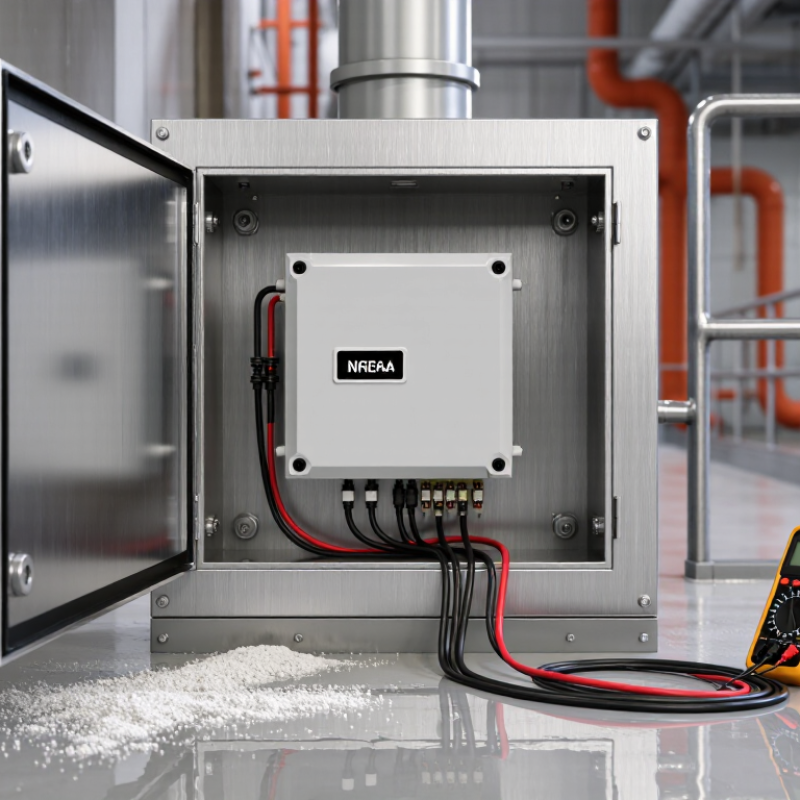
How to Choose NEMA 4X Enclosed Power Supplies?

Define NEMA 4X Protection Using NEMA 250 and UL 50E

NEMA 250 defines enclosure Type 4X for indoor or outdoor use. It addresses windblown dust, rain, sleet, snow, and hose-directed water. It also adds protection against corrosion compared with Type 4. That distinction matters. The rating describes the enclosure’s protection, not the power supply’s performance under every site condition. It is not a submersion rating.

UL 50E sets requirements for enclosure construction and environmental testing. When reviewing a Type 4X claim, check that the enclosure was evaluated to the applicable requirements, rather than judging it by appearance alone. Seams, door gaskets, fasteners, and cable-entry fittings can affect protection. A poorly sealed cable gland may undermine an otherwise robust cabinet.

Match the enclosure to the actual installation. For example, consider salt-laden air, cleaning hoses, direct sun, and the power supply’s heat output. Corrosion-resistant materials help, but a sealed enclosure can trap heat and shorten component life if cooling is inadequate. I would verify both the environmental rating and the manufacturer’s temperature limits. Small details are easy to miss. A Type 4X enclosure does not automatically mean the equipment inside is suitable for every outdoor exposure.

How to Choose NEMA 4X Enclosed Power Supplies

NEMA 4X protection, as defined in NEMA 250 and addressed by UL 50E, adds corrosion protection to Type 4 enclosure protection. The chart compares selected enclosure protection features. A value of 1 means the feature is included for that enclosure type; 0 means it is not specified as a protection of that type.

Choose Type 4X when the installation needs Type 4 protection plus corrosion resistance. Confirm the complete power-supply enclosure’s markings and documentation against the applicable requirements; an enclosure type does not by itself establish suitability for every site condition.

Choose Enclosure Materials for Corrosion and Washdown Exposure

Choosing a NEMA 4X enclosure starts with the environment, not the label alone. NEMA 4X performance includes corrosion resistance and protection against hose-directed water, but the enclosure material still matters. Stainless steel suits many industrial areas where strength and regular washdowns are important. In coastal or chemical-processing settings, 316 stainless steel may resist corrosion better than 304. It also costs more, and it is not immune to every chemical.

Nonmetallic enclosures, such as fiberglass or polycarbonate, avoid rust and can weigh less. They may work well near salt spray or where cleaning agents contact the enclosure. Check chemical compatibility carefully; a cleaner that seems mild can cloud, crack, or weaken a plastic surface over time. Sunlight and heat can also affect some materials. Small details count. Hinges, fasteners, and cable-entry fittings should resist the same exposure as the enclosure body.

Think about how the equipment will actually be cleaned. Will staff spray it from close range? Which detergent is used, and how often? Match the material, gasket, and hardware to those conditions, then verify the complete enclosure’s NEMA 4X rating. Material alone cannot establish that rating. I have seen selection decisions focus on the cabinet and overlook a vulnerable seal. That is an easy assumption to make, and worth checking twice.

Size Output Power: 24 V × 5 A = 120 W; Add 25% Capacity

A 24 V device drawing 5 A requires 120 W under normal operating conditions: 24 volts multiplied by 5 amps. Do not size the supply exactly at 120 W. Add 25% capacity to allow operating margin, which brings the target to 150 W. At 24 V, that equals about 6.25 A. A 24 V, 6.5 A supply would clear that basic threshold, provided its rating applies under your actual installation conditions.

Check the equipment’s full load, not just its label’s typical figure. Pumps, motors, relays, and LED arrays may draw extra current during startup. If the peak demand exceeds the supply’s rating, the voltage can dip or the unit may shut down. Measure where practical, and check the device documentation. A neat calculation can still miss a brief surge.

The enclosure matters, too. A NEMA 4X enclosure helps protect against specified environmental conditions, but it can also trap heat. Verify the power supply’s temperature derating guidance and leave room for airflow where the design allows. In a warm cabinet, a nominal 150 W unit may not deliver 150 W continuously. That detail is easy to overlook. If the load is uncertain, allow more margin and confirm the output voltage at the equipment terminals.

Check Input Voltage, Temperature Derating, and Rated Output

When choosing a NEMA 4X enclosed power supply, verify the input voltage before comparing output ratings. Check the supply’s stated AC or DC input range, frequency, and phase against the site connection. A system that runs near the edge of its input range may behave poorly during voltage dips. That small mismatch matters. Also confirm that the NEMA 4X rating applies to the complete enclosure assembly, not just a component inside it.

Temperature derating deserves close attention. Read the manufacturer’s output-versus-temperature curve, rather than relying only on the headline wattage. In a sealed enclosure, heat can build around the supply, especially near other warm components or in direct sunlight. Use the expected ambient temperature and allow for airflow limits. A tidy calculation can still miss a hot corner. If conditions vary seasonally, check the worst likely operating temperature.

Match the rated output to the actual load, including startup current and any brief peaks from motors or relays. Compare continuous output at the expected temperature, not only the rating at room conditions. Leave margin. A supply running near its limit has less room for load changes and heat-related derating. Record the voltage, current, temperature assumptions, and load estimate; revisit them if the equipment changes.

How to Choose NEMA 4X Enclosed Power Supplies? — Check Input Voltage, Temperature Derating, and Rated Output

Selection factor What to check Practical example or guidance Why it matters
Input voltage Confirm the available AC or DC supply and the power supply’s specified input range. A unit marked 100–240 VAC is intended to operate across that stated range; do not assume every model accepts the same range. Check frequency limits and any output derating at low input voltage. An input range that does not cover the site supply can cause startup problems, shutdowns, or damage.
Output voltage Match the nominal DC output to the connected equipment and confirm its permitted voltage tolerance. For equipment requiring 24 VDC, select a 24 VDC supply and check whether output adjustment is allowed and within the equipment’s limits. Incorrect output voltage can prevent equipment from operating correctly or damage sensitive loads.
Rated output current and power Check both the continuous output-current rating and the wattage rating under the intended operating conditions. For a 24 VDC load drawing 4 A, the calculated load is 24 × 4 = 96 W. A 120 W supply provides a 25% nominal capacity margin, but confirm that temperature and installation conditions do not reduce its available output. The supply must support the load continuously, including any applicable environmental derating.
Startup and peak load Review inrush current, startup duration, and short-term peak demand for motors, solenoids, capacitive loads, or other equipment. Compare the load’s peak-current profile with the manufacturer’s overload and transient specifications; a continuous wattage rating alone may not establish startup compatibility. Some loads briefly demand substantially more current at startup than during normal operation.
Temperature derating Read the output-versus-ambient-temperature curve in the specific product datasheet and use the temperature at the supply’s installation location. If a datasheet specifies reduced output above a stated ambient temperature, size the supply using the reduced rating—not its headline rating. Do not apply a generic derating percentage to every model. High ambient temperature can reduce available output and shorten component life.
Enclosure temperature and ventilation Consider heat from the power supply and other equipment, solar exposure, airflow, mounting orientation, and enclosure material. A sealed enclosure may retain heat. Check the enclosure and power-supply thermal guidance together, and allow for the actual internal ambient temperature. The temperature inside an enclosure can be higher than the surrounding air, affecting derating and reliability.
NEMA 4X suitability Verify that the complete enclosure assembly is rated for the intended location and installation, including cable entries, covers, and accessories. NEMA 4X is associated with protection against specified environmental conditions, including corrosion; it is not a power-supply output rating. Confirm the enclosure manufacturer’s stated rating and installation instructions. A component’s rating does not automatically establish the rating of the assembled enclosure.
Environment and corrosion Identify exposure to moisture, washdown, chemicals, salt air, or other corrosive conditions, and check material compatibility. Confirm that enclosure materials, seals, fasteners, and cable fittings suit the actual environment; “corrosion resistant” does not mean resistant to every chemical. Environmental compatibility depends on the specific materials and exposure conditions.
Protection and compliance Check required electrical protections, applicable safety approvals, grounding instructions, and overcurrent protection. Use the product documentation to verify the approvals and protections required for the installation; do not infer these from the enclosure rating. Enclosure protection and electrical safety certifications address different requirements.
Final selection check Compare the input range, output requirements, temperature-adjusted capacity, enclosure conditions, and installation instructions. Record the expected minimum and maximum input voltage, continuous and peak load, installation ambient temperature, and required enclosure rating before selecting a model. A documented check helps ensure the selected supply suits the complete application, not just its nominal wattage.

Note: The 24 VDC, 4 A, and 120 W figures are an illustrative sizing calculation, not specifications for a particular product. Always use the selected power supply’s datasheet and the enclosure manufacturer’s installation guidance for final selection.

Verify Cable Entries, Grounding, and Seals Before Installation

Before mounting a NEMA 4X power supply, inspect every cable entry against the enclosure’s actual listing and installation instructions. A connector that fits the knockout may still leave a path for water or dust. Check the seal for cuts, flattening, or grit, and confirm the cable diameter falls within the connector’s specified range. Tighten to the manufacturer’s stated torque; guessing can deform a gasket or leave it loose. Small detail. Keep unused openings closed with compatible fittings, not improvised plugs.

Grounding deserves the same care. Verify the protective-earth connection at the designated terminal, remove paint or debris where the instructions require metal-to-metal contact, and tug-test the conductor after tightening. NEMA 250 defines Type 4X enclosure protection, including corrosion resistance and protection against hose-directed water, but the rating depends on maintaining the enclosure as tested. IEC 60529 specifies an IPX6 water-jet test flow of 100 liters per minute; this is useful context, not a direct substitute for NEMA 4X verification. Before energizing, check the cable-entry orientation, seal compression, bonding continuity, and cover seating. I would recheck the cover after wiring; it is easy to trap one wire under the gasket.

FAQS

How much power does a 24 V device drawing 5 A need?

It needs 120 W under normal conditions. That is 24 volts multiplied by 5 amps.

What supply size allows a basic operating margin?

Add 25% capacity, bringing the target to 150 W. At 24 V, that is about 6.25 A. A 6.5 A supply clears this basic threshold, if its rating suits the installation.

Is the device’s typical current enough for sizing?

Not always. Pumps, motors, relays, and LED arrays may draw extra current at startup. Check documentation or measure peak demand where practical.

What can happen if startup demand exceeds the supply rating?

Voltage may dip, or the supply may shut down. A tidy calculation can still miss a brief surge.

Can heat affect a power supply’s output?

Yes. An enclosure can trap heat, and the supply may need to be derated. Check its temperature guidance and allow airflow where possible.

What should I check at cable entries?

Match each connector to the enclosure instructions. Check the seal for cuts, flattening, or grit, and confirm the cable diameter fits. Small detail.

How should unused openings be handled?

Close them with compatible fittings, not improvised plugs. Tighten connectors to the stated torque; guessing can damage a gasket.

What should I verify before energizing the supply?

Check protective grounding, bonding continuity, seal compression, cable-entry orientation, and cover seating. Tug-test the grounding conductor after tightening.

Why inspect the cover after wiring?

A wire can get trapped under the gasket and compromise the seal. I might recheck it, even when the cover looks seated.

Conclusion

Choosing NEMA 4X Enclosed Power Supplies starts with understanding the protection requirements described in NEMA 250 and UL 50E. These standards help assess enclosure performance against environmental exposure, including water and corrosion. Select enclosure materials suited to the installation: stainless steel or appropriate nonmetallic materials may be preferable in corrosive settings or where regular washdown is expected. Confirm that the enclosure’s rating matches the actual operating conditions rather than relying on its appearance alone.

Next, size the power supply for the connected load. For example, a 24 V device drawing 5 A requires 120 W; adding 25% capacity gives a target of about 150 W. Check that the input voltage matches the available supply, and account for temperature derating and the unit’s rated output. Before installation, verify that cable entries, grounding connections, and seals are compatible, secure, and correctly fitted to help preserve the enclosure’s protection.

Seraphina

Seraphina

Seraphina is a highly skilled marketing professional with a deep understanding of the company’s products, customers, and industry landscape. Through years of experience in market research, content strategy, customer communication, and digital promotion, she helps transform complex product......