
Custom OEM certified manufacturing supporting IEEE, IEC, ANSI, and CE standards for utility distribution and heavy industrial applications.
Engineers don't just buy a voltage transformer—they buy non-negotiable operational reliability, tight regulation, and certified thermal headroom.
Full modification of primary/secondary turns ratios, custom mechanical footprints, specialized thermal dissipation fins, NEMA/IP enclosure ratings, and bespoke tap configurations (NLTC/OLTC) tailored to exact OEM specifications.
Every unit undergoes strict partial discharge measurement, full-load temperature rise testing, basic impulse insulation level (BIL) verification, and core loss analysis backed by ISO 9001:2015 quality management procedures.
Engineered to bypass global supply chain bottlenecks. Dedicated OEM rapid-response assembly lines provide expedited prototyping, 3-day emergency dispatch options for critical spare parts, and compliant global sea/air freight exporting.
Voltage transformers (VTs) and potential transformers (PTs) are fundamental magnetic components in modern electric power distribution, industrial process automation, and high-voltage grid control. Operating on the principle of electromagnetic induction, a voltage transformer steps down primary high-voltage line levels to standardized, manageable secondary voltages (typically 120V, 110V, 48V, or 36V). This precise step-down function ensures safe voltage monitoring, metering instrumentation, and reliable energy supply to control circuits, relays, and heavy industrial machinery.
In today's hyper-competitive global energy market, off-the-shelf catalog transformers frequently fail to satisfy stringent spatial, environmental, thermal, and electrical requirements. Consequently, major original equipment manufacturers (OEMs), electrical utility providers, and EPC contractors increasingly rely on Custom OEM Voltage Transformers Manufacturers & Exporters to engineer bespoke magnetic units that guarantee system longevity, minimize magnetic core losses, and withstand severe operating conditions.
Key Takeaway for Sourcing Engineers: Custom OEM voltage transformer design goes far beyond selecting voltage ratios. It requires balancing copper vs. aluminum winding metallurgy, optimizing Cold-Rolled Grain-Oriented (CRGO) steel vs. amorphous core geometries, managing Class H insulation thermal dissipation, and assuring compliance with IEEE C57, IEC 60076, and CE standards.
At the core of every custom voltage transformer lies Faraday’s Law of Electromagnetic Induction. The induced electromotive force (EMF) in the secondary winding is directly proportional to the rate of change of magnetic flux and the physical turn ratio between primary ($N_p$) and secondary ($N_s$) windings:
V_p / V_s = N_p / N_s = I_s / I_p
When engineering custom OEM transformers, electrical engineers must account for non-ideal parameters, including leakage reactance, core hysteresis, eddy current losses, and winding resistance. The optimization of these factors dictates the transformer's voltage regulation efficiency and temperature rise under continuous full-load conditions.
| Transformer Topology | Primary Voltage Range | Secondary Voltage Output | Cooling / Insulation Type | Primary OEM Applications |
|---|---|---|---|---|
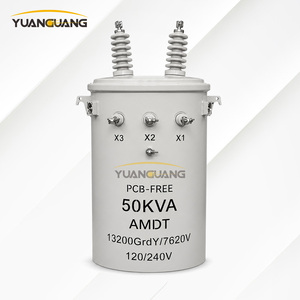
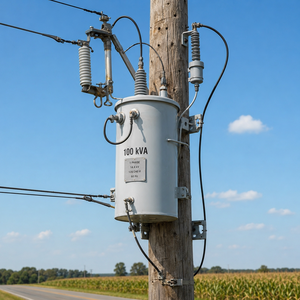
| Single-Phase Overhead Pole Mounted | 4.16kV - 13.8kV (GrdY/7.97kV) | 120V / 240V Dual Output | Mineral Oil / Biodegradable Ester (ONAN) | Utility overhead distribution, storm restoration, rural electrification. |
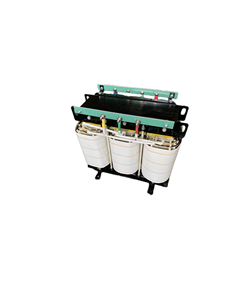
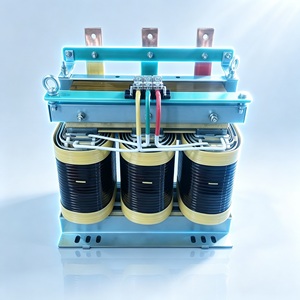
| Three-Phase Step-Down / Converter | 11kV / 33kV | 415V / 220V / 110V | Oil-Immersed (ONAN/ONAF) or Dry-Type (AN) | Industrial plants, step-down substations, renewable energy farms. |
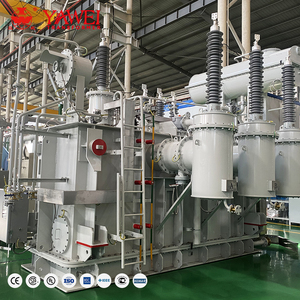
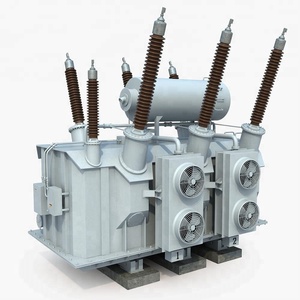
| High Voltage Substation Power Unit | 100MVA - 250MVA (up to 500kV) | 33kV / 11kV Sub-Transmission | Forced Oil Forced Air (OFAF/ODAF) with NLTC | Transmission grids, regional utility substations, heavy metallurgy plants. |
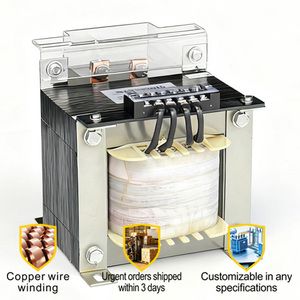
| Low-Voltage Industrial Isolation | 0.8kV / 0.38kV (380V) | 0.22kV / 0.11kV (220V/110V) | Dry-Type Cast Resin / VPI (Class H) | Process control panels, CNC machinery, variable frequency drives (VFD). |
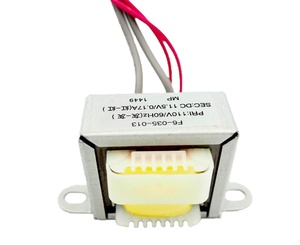
| Machine Tool Control Transformer | 110V / 220V / 440V Single Phase | 36V / 48V Safety Low Voltage | Dry-Type Air Cooled (IP20/IP54 Enclosure) | Packaging automation, textile machinery, safety lighting circuits. |
Choosing the correct transformer architecture depends on system grid topology, load characteristics, and structural mounting constraints:
Pole-mounted distribution transformers (ranging from 10kVA, 15kVA, 25kVA up to 75kVA) serve as the backbone of overhead power distribution in North America, South America, and global rural utilities. Engineered to comply with IEEE C57.12.20 standards, these units convert medium distribution voltages (such as 4.16kV or 13.8kV GrdY) down to residential and light commercial 120/240V split-phase supply.
Modern CSP (Completely Self-Protected) single-phase units integrate internal primary high-voltage fuses, secondary thermal circuit breakers, and heavy-duty lightning arresters directly onto the tank body. This integrated protective approach eliminates external cutout switches, dramatically simplifying pole installation during emergency utility replacement and storm restoration initiatives.
For industrial manufacturing facilities, data centers, and commercial complexes, three-phase transformers (11kV/33kV step-down to 415V/220V/110V) deliver balanced phase power with high energy efficiency. Available in both oil-immersed and dry-type cast resin configurations, these transformers feature customizable vector groups (e.g., Dyn11, YNd11) to manage neutral displacement and suppress third-harmonic distortion created by non-linear electronic loads.
At the grid transmission level, 100MVA to 250MVA power transformers operating at 220kV to 500kV require advanced electromagnetic simulation to mitigate stray magnetic flux and localized hot-spot formation. Equipped with No-Load Tap Changers (NLTC) or On-Load Tap Changers (OLTC), these massive transformers adjust turns ratios dynamically to maintain grid voltage stability across fluctuating peak loads.
In automated packaging machinery, CNC centers, and medical devices, low-voltage dry-type isolation transformers (0.8kV down to 0.11kV, 36V, or 48V) provide galvanic isolation between primary grid noise and sensitive digital microcontrollers. By incorporating electrostatic copper shielding between primary and secondary windings, common-mode electrical noise is shunted directly to ground, preserving signal integrity in automated control loops.
How global energy transitions, decarbonization mandates, and smart grid digitizations are reshaping custom magnetic purchasing.
As power grids transition toward renewable energy integration and industrial automation becomes increasingly complex, purchasing managers and chief electrical engineers must align their procurement strategies with four emerging market vectors:
Modern OEM transformers now incorporate embedded fiber-optic temperature sensors, digital oil condition monitoring, and wireless partial discharge indicators. Real-time data feeds directly into utility SCADA systems, enabling predictive maintenance before catastrophic insulation breakdown occurs.
Environmental regulations (such as EU EcoDesign and US DOE efficiency standards) are driving rapid phase-out of traditional mineral oils in favor of natural and synthetic ester fluids. Ester liquids feature high fire points (>300°C) and full baseline biodegradability, making them ideal for ecologically sensitive areas and dense urban substations.
Extreme weather events require utilities to maintain rapid-response transformer reserves. Custom OEM manufacturers are responding with standardized universal-bushing pole-mount units designed for quick field interchangeability across diverse medium-voltage distribution systems.
Direct technical answers to common engineering questions regarding transformer sizing, thermal rise, certification, and lead times.
To provide an accurate technical proposal and pricing, our engineering team requires: (a) Primary and secondary rated voltages and frequency (50Hz/60Hz); (b) Power rating in kVA or MVA; (c) Number of phases (single-phase vs. three-phase); (d) Cooling method (Dry-type AN/AF or Oil-immersed ONAN/ONAF); (e) Insulation class and temperature rise limit (e.g., 65°C, 80°C, 115°C); (f) Basic Impulse Insulation Level (BIL) requirement; (g) Enclosure IP/NEMA rating; and (h) Applicable standards (IEEE, IEC, ANSI, CE).
Copper windings offer superior electrical conductivity, lower volume footprints, and high mechanical resistance to short-circuit stress, making them ideal for compact industrial enclosures and heavy-duty step-down transformers. Aluminum windings, while requiring slightly larger physical core volume to achieve equal current-carrying capacity, deliver up to 30-40% weight reduction and significant cost savings for utility pole-mounted distribution applications.
Standard engineering CAD drawings and 3D schematic submittals are completed within 3 to 5 business days. Rapid prototyping for low-voltage control and dry-type isolation transformers typically ships within 2 to 3 weeks. High-voltage oil-immersed transformers and substation power units range between 6 to 10 weeks depending on raw material procurement, specialized testing, and custom tank fabrication requirements.
A No-Load Tap Changer (NLTC) allows manual adjustment of the transformer’s primary winding turns ratio to compensate for seasonal grid voltage drift, but requires the transformer to be completely de-energized before switching. An On-Load Tap Changer (OLTC) contains automated motorized switching mechanisms that adjust voltage ratios seamlessly while the transformer remains fully energized under load, essential for maintaining stable voltage in transmission-level substations.
Yes. All OEM transformers are manufactured under ISO 9001:2015 certified quality systems. Depending on your destination market, we supply full compliance documentation for IEEE C57, IEC 60076, ANSI C57, CE Marking, UL recognized insulation systems, and TAA compliance for US government and defense procurement requirements.
For demanding industrial environments, dry-type transformers are manufactured using Vacuum Pressure Impregnation (VPI) with high-grade polyester varnish or fully encapsulated in epoxy resin (Cast Resin Transformers). Coupled with NEMA 3R, NEMA 4X, or IP54 stainless-steel enclosures, these units are completely sealed against moisture, dust ingress, airborne salt, and corrosive chemical environments.